

Moving Beyond Ambition: Scaling Low-Carbon Refining Solutions
The technologies and strategies helping Latin American refiners balance emissions reduction, operational performance and commercial viability.
Part of the Latin American Refining Key Takeaways Report 2026 series, this article draws on insights shared by senior industry leaders at LARTC 2026 in Buenos Aires.
The energy transition is becoming an increasingly practical challenge for refiners, requiring them to balance environmental ambitions with profitability, capital constraints and competitive positioning.
The challenge is no longer simply to identify lower-carbon technologies, but to determine which solutions can be deployed at scale while maintaining operational performance and commercial viability. Investment decisions must consider not only emissions-reduction potential, but also economic returns, technical feasibility and evolving market demand.
The challenge is no longer simply to identify lower-carbon technologies, but to determine which solutions can be deployed at scale.
Renewable feedstock co-processing offers a potential near-term pathway to reduce the carbon intensity of existing refining operations, while sustainable aviation fuel (SAF) is creating new opportunities and challenges across production and supply chains.
Scaling these solutions depends on the availability and cost of suitable feedstocks, sustainability requirements, logistics and production economics. Securing reliable supplies and integrating alternative raw materials into existing assets will be critical to translating decarbonisation ambitions into commercially viable operations.
Hydrogen pathways and the adaptation of refinery configurations also form part of the broader transition challenge. Refiners must assess the technical and economic feasibility of integrating lower-carbon solutions into existing infrastructure, while responding to changing product demand and optimising their portfolios.
These decisions require careful evaluation of investment needs, operational constraints and long-term market prospects, particularly where capital must be allocated between decarbonisation initiatives and the competitiveness of existing assets.
Decarbonisation investment must be balanced against the competitiveness of existing assets.
Digitalisation, industrial data and artificial intelligence can support decarbonisation by improving operational visibility, optimisation and emissions management.
Their contribution will depend on the ability to translate data into actionable insights, identify opportunities to reduce energy consumption and emissions, and integrate these capabilities into day-to-day refinery operations.
Digital tools should therefore be viewed as enablers of a broader operational and strategic transformation, rather than standalone decarbonisation solutions.
Ultimately, scaling low-carbon refining solutions requires an integrated approach that connects technology, feedstock supply, infrastructure, market demand and investment discipline.
The transition will not follow a single pathway across all refineries; the most viable options will depend on each asset’s configuration, regional supply chains and competitive context.
Success will depend on selecting solutions that deliver credible emissions reductions while preserving economic resilience and the ability to adapt to an evolving energy market.
Success will depend on selecting solutions that deliver credible emissions reductions while preserving economic resilience.
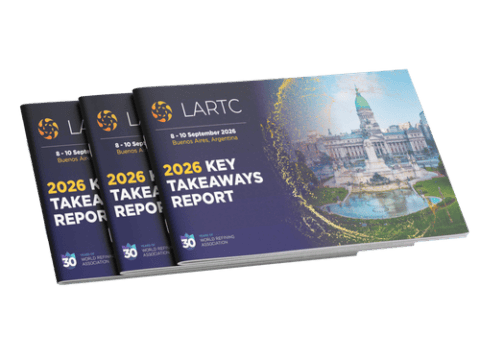
Latin American Refining Key Takeaways Report 2026
Explore further insights and perspectives shared by senior industry leaders at LARTC 2026 in the full Latin American Refining Key Takeaways Report 2026.
Up next: LARTC Ask the Experts
The conversation doesn’t end in Buenos Aires.
At LARTC Ask the Experts on 4-5 May 2027 in Rio de Janeiro Brazil, continue exploring the questions, challenges and opportunities shaping Latin America’s refining industry, with insights from experienced industry leaders.


Join Us at LARTC 2027 in Cartagena
The next Latin American Refining Technology Conference (LARTC) will return on September 7-9 2027 in Cartagena, Colombia.