

The Margin Advantage: Getting More from Every Barrel
How energy efficiency, reliability and digital technologies can help Latin American refineries optimise performance, reduce costs and improve competitiveness.
Part of the Latin American Refining Key Takeaways Report 2026 series, this article draws on insights shared by senior industry leaders at LARTC 2026 in Buenos Aires.
For Latin American refineries, energy efficiency is increasingly a strategic differentiator. But reducing energy costs cannot be separated from maintaining reliability and operational availability.
A cheaper energy configuration may ultimately prove more expensive if it increases the risk of interruptions or production losses. The real objective is therefore not simply to minimise energy consumption or cost, but to optimise the overall performance and competitiveness of the refinery.
The real objective is not simply to minimise energy consumption or cost, but to optimise the overall performance and competitiveness of the refinery.
The focus is shifting from optimising individual pieces of equipment to redesigning the refinery’s entire energy architecture. This broader perspective recognises the interdependence of energy systems, production processes and operational decisions.
It also highlights an important distinction: efficiency measures how well equipment operates against its design, while performance measures how effectively the overall system meets business objectives.
Investment prioritisation must consequently go beyond conventional payback calculations.
The strongest decisions balance energy cost, reliability, availability, emissions, operational flexibility and risk, identifying projects that maximise total business value rather than those offering the most attractive isolated return. This is particularly important when capital is constrained and improvements to one part of the energy system may create trade-offs elsewhere.
The strongest investment decisions maximise total business value, not just isolated returns.
Significant opportunities emerge when energy is treated not merely as a fixed operating cost, but as a variable that influences process performance, production and margins.
Better planning, integrated energy management and the optimisation of energy-intensive processes can help refineries respond to changing operating conditions while protecting availability.
Digital tools, predictive analytics and artificial intelligence can support this effort by improving energy-consumption forecasts, identifying inefficiencies and informing operational decisions.
Ultimately, energy efficiency should be embedded in the refinery’s operating model rather than managed as a collection of isolated projects.
Regular energy reviews, consumption planning, clear objectives and indicators, and continuous monitoring help turn efficiency into an ongoing operational discipline. The greatest gains come from combining technical improvements with system-wide optimisation and a culture of operational excellence.
The greatest gains come from combining technical improvements with system-wide optimisation and a culture of operational excellence.
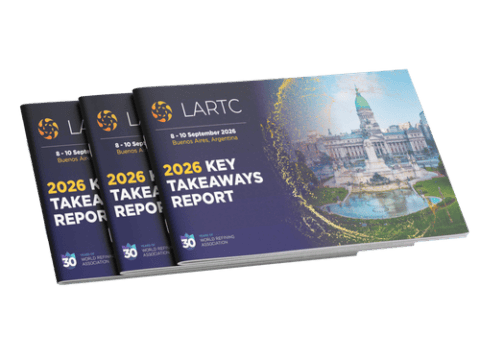
Latin American Refining Key Takeaways Report 2026
Explore further insights and perspectives shared by senior industry leaders at LARTC 2026 in the full Latin American Refining Key Takeaways Report 2026.
Up next: LARTC Ask the Experts
The conversation doesn’t end in Buenos Aires.
At LARTC Ask the Experts on 4-5 May 2027 in Rio de Janeiro Brazil, continue exploring the questions, challenges and opportunities shaping Latin America’s refining industry, with insights from experienced industry leaders.


Join Us at LARTC 2027 in Cartagena
The next Latin American Refining Technology Conference (LARTC) will return on September 7-9 2027 in Cartagena, Colombia.