
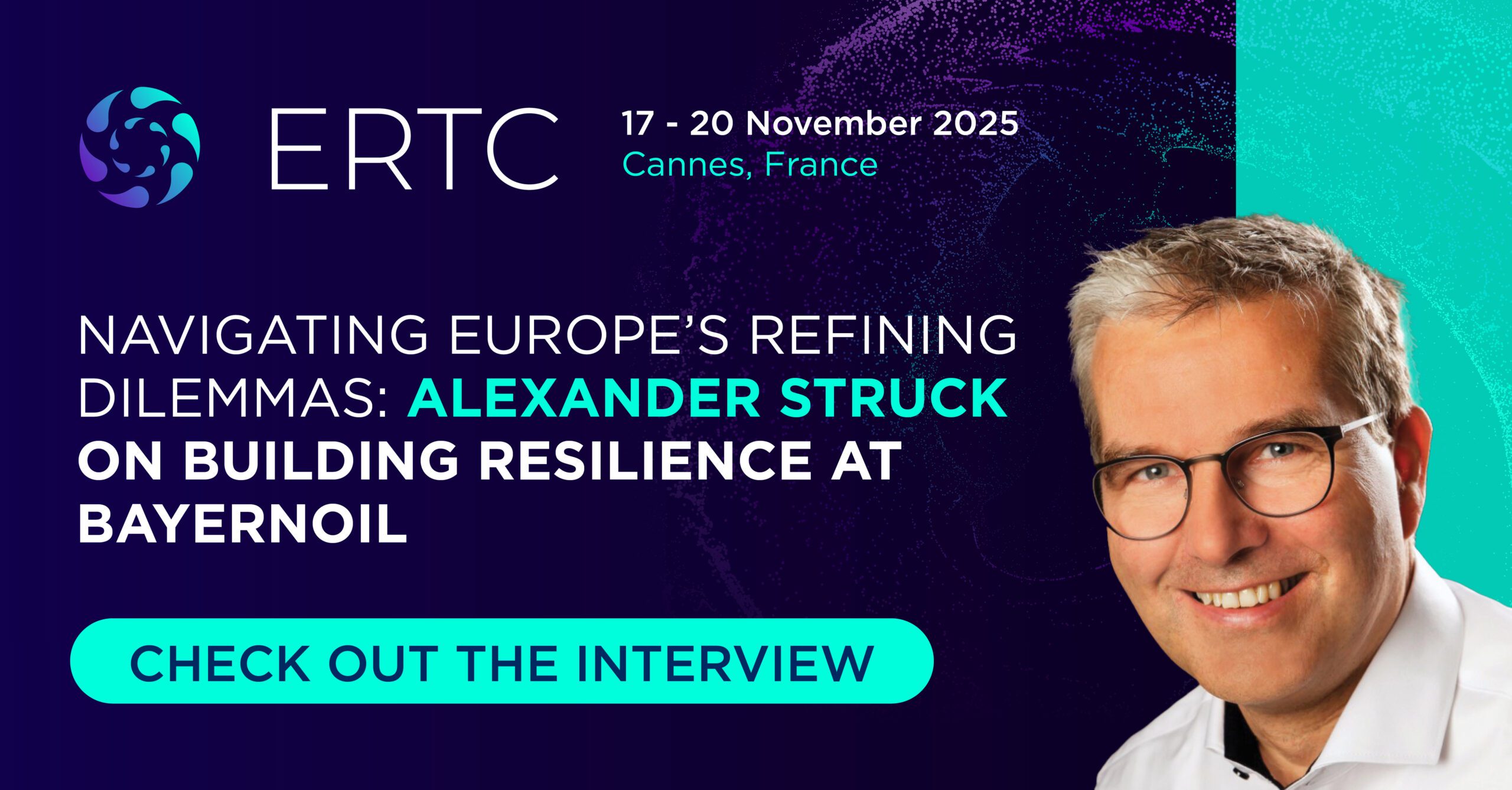
Navigating Europe’s Refining Dilemmas: Alexander Struck on Building Resilience at Bayernoil
From your perspective, what is the biggest challenge European refiners face today in maintaining competitiveness during the energy transition?
The difficulty is that there is no defined transition path from our past fossil business to a future renewable refinery business.
I believe there are three dilemmas in particular:
- Aging refineries require continuous investment in the existing plants to operate safely and reliably while, on the other hand, the current regulation stipulates the phase-out and shutdown of the conventional part of the business in the not too distant future
- The customer requires continuous, reliable and cheap supply of energy while the regulation requires “green”, CO2-free fuels which are significantly more costly (ie. nobody would produce it without regulatory force)
- Many customers and applications will need (liquid or gaseous) molecules in the long term, while many regulators seem to think (or at least act like) all future energy demand can be supplied via green power
These uncertainties stand in the way of required investments and the key for European refiners will be to find a way to manage these dilemmas – jointly with investors, regulators and the society.
How do you see the role of traditional refineries evolving in the next decade as Europe accelerates towards net-zero targets?
Currently, there is no real, consistent “acceleration” towards net-zero visible in European politics. Refiners will need to use the current period of uncertainty to position themselves well for a variety of future scenarios – continue the current path of traditional energy supply as well as identifying investment options for renewable energy supply.
While a traditional refinery consists of crude distiller, vacuum unit, reformer, FCC and the likes, it seems pretty obvious that a refinery of the future will have to include units like electrolyser, HVO unit, chemical recycling/pyrolysis, E-fuels/synfuel production and CO2 separation units.
The big question is if, how and when the huge investments that are required for this transition can and will be triggered.
What does “long-term resilience” mean for Bayernoil in the current geopolitical and economic environment?
“Long term resilience” will mean successful management of the above-mentioned dilemmas. We should not underestimate the importance of the role of refineries as critical infrastructure – this is a lever for an intense dialogue with regulators and politicians to identify and implement a feasible transition path.
Currently, the German “Energiewende” is dominated by ambitions to switch to renewable power. For its success, and the long-term future for refiners, it will be an essential task to develop the “Molekülwende” as an integral part of this journey. In this spirit, Bayernoil is in close contact and constructive conversation with regional and national regulators and lawmakers.
Note: The term “Molekülwende” (molecule transition) has been established by the industry association EN2x, further information is available here: Argumentationspapier zur Molekülwende Europawahl englische Fassung – en2x
How is Bayernoil aligning its operations with EU climate targets and Fit-for-55 regulations?
Our strategy stands on two legs:
- The base line is operational excellence and further optimisation of the fossil business. This includes cost and energy efficiency initiatives as well as various options to fulfil increasing renewable quota, like blending, trading or collaboration with suppliers.
- In parallel, we are preparing our options for a potential future renewable energy business to be ready for investment once the conditions are given.
Hear from Alexander Struck live at ERTC 2025
-
- Day 3: 20 November, 15:40 | Keynote Panel Discussion: Sustainable Action Fuel (SAF) in Europe: Paving the Way for a Green Future
>> Download the Agenda <<
Do you think current EU policies adequately support the refining sector’s transition, or do you see gaps that need to be addressed?
The key for all investments in our capital intense industry is long-term clarity or at least confidence. There are three areas where those conditions are not yet given, and people see more risks than they have confidence:
- Technical risks – many technologies for renewable energy production are still in its early development. This can and will be overcome by our industry – but requires research and development support, subsidies or even more attractive business cases.
- Regulatory risks – nearly all business cases for investments are driven by regulatory requirements. Hence, regulations need to provide long-term clarity for the full pay-back period of any investment, without the risk to be overthrown after the next election.
- Business case risks – regulatory clarity alone is not necessarily sufficient, for a sound business case there must be defined pricing ranges or other mechanisms (auctions, taxes, grandfathering, …) that secure or incentivize investment.
What skills and capabilities do you believe will be most critical for the refinery workforce of the future?
Managing through the current VUCA (volatile, uncertain, complex, ambiguous) conditions is tough for many of our current employees. We need to foster resilience and self-motivation, supported through openness, transparency and authenticity. We can only motivate our current workforce as well as attract new talent, if we are able to express a long-term perspective for our business as an essential element of critical infrastructure for our society – be it fossil or renewable.
Hear from Alexander Struck live at ERTC 2025
-
- Day 3: 20 November, 15:40 | Keynote Panel Discussion: Sustainable Action Fuel (SAF) in Europe: Paving the Way for a Green Future
>> Download the Agenda <<