
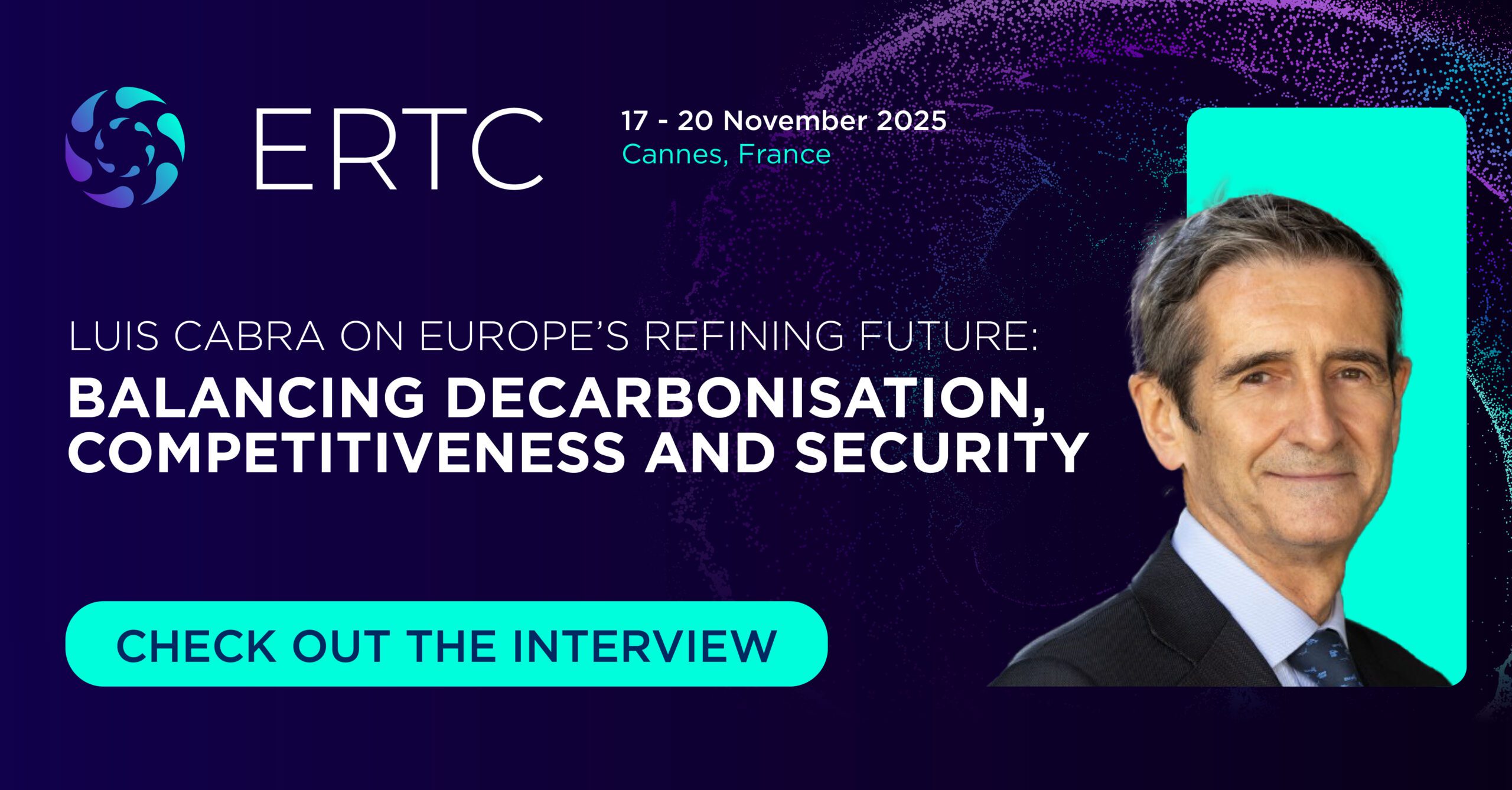
Repsol’s Luis Cabra on Europe’s Refining Future: Balancing Decarbonisation, Competitiveness and Security
Repsol’s Luis Cabra urges a pragmatic, technology-open transition that safeguards jobs, energy security, and competitiveness. He highlights Repsol’s investments in biofuels, synthetic fuels, hydrogen, and circular economy projects, while calling for EU policies that treat fuel manufacturing as strategic to achieving net zero.
How do you see the European refining and energy industry evolving over the next decade in light of geopolitical and regulatory pressures?
The European refining and fuel manufacturing industry is strategic for Europe, as it powers 97% of transport in the EU, moving people and goods and sustaining other key sectors like chemicals and defense. It is a “silent” industry, always there where and when needed.
Even during the worst of the COVID pandemic, our refineries and our people continued working, and no essential service was left without supply. But our industry has somehow been forgotten in policymaking or at least subordinated to other sectors’ strategies.
This comes at a cost.
Since 2009, of the more than 100 refineries operating in Europe, 28 have been closed. Each closure erodes Europe’s industrial capacity, regional jobs, and supply resilience, weakening entire value chains. Europe is now a net importer of jet fuel and gasoil.
At the same time, refining, like other energy-intensive industrial sectors, is under growing regulatory and geopolitical pressures in Europe. Recent crises, from Russia’s invasion of Ukraine to instability in the Middle East, have exposed how quickly supply chains can falter when domestic capacity is eroded.
Without a clear and forward-looking energy transition plan, further premature closures would be inevitable, deepening Europe’s reliance on imports and weakening its energy security.
The European Commission’s Clean Industrial Deal must therefore place fuel manufacturing on the same strategic footing as steel, chemicals, automotive, and other key sectors, and establish a dedicated transition pathway with an Action Plan to steer investment in decarbonisation of its operations and products.
The industry is ready to deliver. It is already investing in renewable and low-carbon fuels and products, manufactured in Europe, preferably from European raw materials, and distributed via an existing, resilient logistics network.
These investments safeguard supply, sustain quality jobs, and provide affordable products, while enabling Europe’s decarbonisation.
What are your key strategic priorities at Repsol as the company advances its energy transition agenda?
At Repsol, our strategic priority in the energy transition is to lead a realistic and technologically open transformation of the energy system.
We are fully committed to achieving net-zero emissions by 2050; we were the first company in our sector to announce this commitment in 2019, aligned with the Paris Agreement and EU climate goals.
This transition must be economically viable, socially fair, and grounded in technological and industrial reality. There is no single path to decarbonisation.
Accelerating emissions reduction requires a multi-energy, multi-technology approach, including electrification, renewable and low-carbon fuels, and carbon capture. Technological neutrality means using every available solution to decarbonise faster and more efficiently.
Repsol is evolving as a geographically focused, multi-energy supplier. Our operations integrate oil and gas production, refining, chemicals, renewable electricity generation, and multi-energy customer solutions. We see decarbonisation as a business opportunity. From 2024 to 2027, 35% of our net investment will be allocated to low-carbon projects.
The world will need oil and gas for decades, as well as an increasing share of renewables. Non-renewable energy still accounts for 80% of the energy mix, just slightly less than 50 years ago. Repsol Upstream strategy focuses on optimizing O&G fields for higher economic margin and lower carbon intensity barrels.
Renewable electricity generation is for us a growth vector, mainly in Spain and the U.S. In just a few years, we have created a new business from scratch. Five years after entering electricity commercialization, we are the fourth Spanish retailer.
We are also heavily investing in our refineries for a profitable decarbonisation, with the capacity to continue processing oil, but also other renewable raw materials (used cooking oils, municipal waste or agroforestry biomass) to manufacture fuels and products with low carbon footprint: SAF, advanced biofuels, hydrogen and synthetic fuels. To complete the circle, we are marketing renewable fuels.
Our Nexa Diesel 100% renewable for road is now available at more than 35% of our service stations in Spain and growing together with over 3,200 public electric fast charging points across the Iberian Peninsula.

Hear from Luis Cabra live at ERTC 2025
-
- Day 1: 18 November, 09:55 | Opening Keynote Panel Discussion: The Geopolitical Trilemma – Balancing Energy Security in a Volatile World
- Day 1: 18 November, 11:55 | 1:1 Interview: Advocacy, Advocacy, Advocacy: Shaping the Regulatory Landscape
>> Download the Agenda <<
What are the biggest barriers facing European industry in balancing decarbonisation with competitiveness and energy security?
European industry is under pressure to decarbonise rapidly while staying globally competitive and maintaining secure, affordable energy supplies. High energy and CO2 prices, the cost of low-carbon technologies, and the need for energy security add to the pressure. Achieving climate goals must be economically viable or Europe risks losing its industrial base.
Europe is falling behind global competitors. The weight of industry in the EU GDP and productivity have declined over the past two decades, while other world regions benefit from lower energy costs and a more supportive regulatory environment. Complex rules, high CO2 costs and fragmented policies further burden European companies.
This creates a risk of carbon leakage and industrial relocation. The recently passed CBAM (Carbon Border Adjustment Mechanism) is being challenged by many countries, as a barrier to trade. The EU cannot impose rules on the rest of the world; we need more international cooperation and regulatory alignment.
How is Repsol integrating energy transition technologies into its downstream and industrial operations?
Repsol is transforming its industrial sites by integrating circular-economy solutions, renewable energy production, efficiency improvements, and pioneering low-carbon fuel technologies while offering its customers a broad range of energy solutions.
Spain’s first 100% advanced biofuels plant is operating since 2024 in our Cartagena refinery, producing fuels for all modes of transport from lipidic waste. With an annual capacity of 250,000 tons, it will avoid CO2 emissions equivalent to putting 400,000 electric vehicles on the road, approximately the current total fully-electric car fleet in Spain. A second biofuel production plant is scheduled to start up in 2026 in our Puertollano refinery with a capacity of 200,000 tons per year.
In Tarragona, Ecoplanta—the first project of its kind in Europe and a €800 million investment supported by EU Innovation Funds—will convert 400,000 tons of non-recyclable municipal waste into 240,000 tons/year of renewable and circular methanol.
Repsol is also building a demo plant in our Bilbao refinery to produce synthetic fuels from electrolytic hydrogen and captured CO2. Starting in 2026, it will produce approximately 2,000 tons/year of synthetic fuels (road, marine, aviation), to test the products, de-risk technologies and reduce costs.
The timing of these projects reflects technological maturity: lipid conversion is mature, waste gasification is first-of-a-kind, and synthetic fuels are still at demo stage. This sends a strong signal to policymakers: targets and obligations for low-carbon fuels must be realistic, based on technology’s maturity and costs.
Finally, as the largest producer and consumer of hydrogen in Spain, Repsol is also investing in electrolyzers for the production of green hydrogen in our refineries, totaling more than 460 MWe capacity.
What role do advanced biofuels and renewable fuels of non-biological origin (RFNBOs) play in Europe’s climate and energy security goals?
As the energy transition advances, one reality becomes clear: there is no single route to climate neutrality. Decarbonising transport and industry, two of the most emission-intensive sectors, will require a portfolio of solutions tailored to different contexts. In this mix, both advanced biofuels and renewable fuels of non-biological origin (RFNBOs) will play a role.
These fuels are not a distant prospect.
Conventional and advanced biofuels from lipidic origin are already available, scalable, and compatible with existing infrastructure and vehicles, thus delivering immediate emissions reductions.
Synthetic fuels, which are RFNBOs if produced from electrolytic hydrogen and captured CO2, need further development to scale up and reduce costs.
This is why we advocate for electrolytic hydrogen used as an intermediate product to produce biofuels to be qualified in regulation as RFNBO, as the way to comply with the mandated volumes as soon as in 2030.
In transport, biofuels and e-fuels will complement electrification, enabling a faster and more cost-efficient transition without extensive infrastructure upgrades or disruptive structural changes, and providing more options to the consumer.
Their benefits go beyond emissions if produced in Europe, as they strengthen Europe’s energy security. Using preferably available local feedstocks enhances strategic autonomy, supports rural economies, and drives the circular economy by transforming non-recyclable waste, such as used cooking oils, animal fats and agricultural residues, into energy.
Their benefits go beyond emissions if produced in Europe, as they strengthen energy security, support rural economies, and drive the circular economy
Integrating renewable hydrogen into liquid fuels production also accelerates hydrogen demand without waiting for dedicated new hydrogen uses to be developed for mobility and industry.
To fully harness this potential, we need policies that promote all decarbonisation options and stimulate private investment through incentives, not prohibitions. Recognising renewable liquid fuels in road transport regulations is a non-regret proposition.
It will accelerate renewable liquid fuel production at lower cost, also for aviation and shipping, as co-producing fuels for all modes of transport is the only way to attain economies of scale and cost-competitiveness. It will also help the automotive industry to comply with its obligations to decarbonise their vehicle fleets, without paying punitive penalties.
On the other hand, it is important to develop a harmonised life-cycle emissions accounting methodology to properly assess their decarbonisation potential and ensure international harmonization.
From your perspective as President of FuelsEurope, how can policymakers and industry better align to deliver a credible and resilient transition?
A credible and resilient transition can only succeed if it is rooted in industrial reality and built on collaboration, pragmatism and flexibility.
First, embrace technological inclusiveness. There is no one-size-fits-all transition pathway. Policymakers should allow each energy consuming party to choose the most cost-effective route to cut emissions, electrification where it works best, or renewable/low-carbon fuels where they deliver faster or cheaper abatement. These options are not rivals but complements.
Second, think in a holistic way, not in silos. Fuel manufacturing is an integrated industrial activity: refineries co-produce fuels for road, aviation, and maritime from the same assets, using the same building blocks, carbon and hydrogen. Policies that support only one sector (e.g., aviation) while constraining others (e.g., road transport) create economic inefficiencies and destroy future investment.
To improve regulation, a value-chain approach is essential to secure feedstocks, develop and scale processing technologies, enable flexible hydrogen sourcing, and enlarge use of fuels for all market applications.
Selective and targeted regulatory improvements that unlock more investment are at hand.
Key priorities include recognizing combustion vehicles that use the new fuels as zero-emissions in vehicle standards regulations, adopting reduced taxation under the revised Energy Taxation Directive, and eliminating unnecessary restrictions for sustainable feedstocks in the RED III, among a few others.
Looking ahead, what gives you optimism about the energy transition—and where do you think the greatest risks lie?
Looking ahead, I am optimistic because I believe in the power of science and technology. Technological innovation is accelerating, and many companies are investing in renewable electrons and molecules, and other technologies like carbon capture or those related to higher energy efficiency. There’s growing recognition that no single solution will get us to net zero.
There’s growing recognition that no single solution will get us to net zero.
This optimism is reinforced by a shift in mindset within the European Union in the new political cycle that started last year. Initiatives like the Clean Industrial Deal, the Competitiveness Compass, and the upcoming Sustainable Transport Investment Plan reflect a more pragmatic and open approach, that now needs to materialize in concrete regulation improvements, balancing decarbonisation, energy supply security, affordable price of energy and industrial competitiveness.
The main risks for me are inertia and polarization.
On one side, there is a natural resistance to change. We all need to recognize that, despite the positives of the way the energy transition has been managed in the EU regulation during the last years, there are things that need to be improved.
On the other side, there is a risk that the climate change debate is politically polarized: either you are activist or negationist.
We should all have the same objective, which is mitigating global warming to a level that avoids putting our planet at risk, while having access to secure and affordable energy, essential for people’s wellbeing and the progress of society.
Technology, rather than ideology, will be the solution.
Hear from Luis Cabra live at ERTC 2025
-
- Day 1: 18 November, 09:55 | Opening Keynote Panel Discussion: The Geopolitical Trilemma – Balancing Energy Security in a Volatile World
- Day 1: 18 November, 11:55 | 1:1 Interview: Advocacy, Advocacy, Advocacy: Shaping the Regulatory Landscape
>> Download the Agenda <<