
LARTC 2025
Scaling sustainable aviation fuel in Latin America: drivers, hurdles, and solutions

Fuelling the Change: Policy and Ambition
Sustainable aviation fuel (SAF) is key to decarbonising global aviation, offering lower greenhouse gas (GHG) emissions than fossil fuel. In Latin America, its adoption is driven by international commitments, local policies, and regional feedstock potential. On the international stage, the Carbon Offsetting and Reduction Scheme for International Aviation (CORSIA), established by the International Civil Aviation Organization (ICAO), is the primary market mechanism driving SAF adoption. ICAO predicts that aviation emissions will double or triple by 2050, but airlines must offset any CO₂ emissions above 85% of their 2019 levels from 2024 through 2035, with all ICAO member states required to comply from 2027 (with exemptions).1,2 Airlines can use SAF or buy offsets to meet their obligations under this mandate. Corporate net-zero goals, such as LATAM’s 5% SAF use by 2030, make SAF central to decarbonisation. While CORSIA fosters international coordination, its success relies on local policies.
Policy Levers: Unlocking Latin America’s SAF Potential
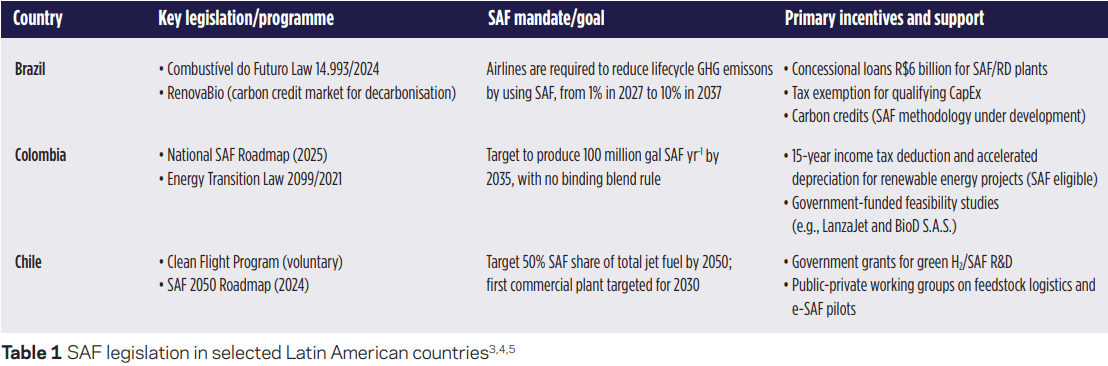
Local mandates and funding will determine whether SAF can expand across Latin America. An overview of the SAF legislation and market in the region is outlined in Table 1 for selected countries. Brazil has a blending mandate starting at 1% by 2027, supported by the RenovaBio policy and SAF investment incentives.⁴ Meanwhile, Colombia and Chile have long-term goals targeting 2035 and 2050, respectively.3,5 Long-term policies, economic factors, local mandates, and the market environment are all crucial for the growth and scaling of the SAF market throughout Latin America.
From Soybeans to Palm Oil: Latin America’s Diverse SAF Feedstock Potential
Brazil uniquely has a firm SAF blending mandate and incentives, supported by abundant feedstocks, including 11.5 million tonnes per year of soybean oil and 1.36 million tonnes per year of tallow in 2024.⁶ Colombia, with approximately 1.8 million tonnes per year of palm oil in 2023,7 primarily uses it for methyl ester biodiesel production; however, its use as a feedstock for SAF production is controversial due to sustainability concerns.
Chile lacks large-scale oilseed production, and its feedstocks, primarily animal fats and used cooking oil, are limited and are being studied for future SAF use.
Uruguay produces around 300,000-350,000 metric tonnes per year of soybean oil annually, with tallow estimates closer to 40,000-50,000 metric tonnes per year.₈ Additionally, its development is geared toward non-edible oilseed crops and biogas-to-SAF. Feedstock is essential to developing a local SAF ecosystem, but it is only the first part of the equation
Scaling SAF: Production Growth and Economic Hurdles in Latin America
Currently, Latin America has four operational hydroprocessed esters and fatty acids (HEFA) co-processing plants: three in Brazil and one in Colombia. Petrobras leads Brazil’s SAF efforts with several co-processing and HEFA facilities. Additionally, Brazil may develop up to 10 co-processing plants and five HEFA plants by the end of the decade. In Colombia, Ecopetrol’s Cartagena refinery has been producing SAF from used cooking oil since 2024. Additionally, there is increasing interest in first-generation alcohol-to-jet pathways using corn and sugarcane bioethanol. Two such projects have been announced, aiming for operations by 2030, though neither has reached a final investment decision (FID).
However, the economics of SAF remain challenging. The minimum selling price of HEFA-derived SAF is usually at least twice that of conventional jet fuel. Feedstock costs make up more than 80% of HEFA production expenses, with hydrogen, catalysts, and fixed costs constituting the rest. Price fluctuations are significant, with changes of 10–20% occurring within a few months over the past two year. As a result, long-term offtake agreements and feedstock supply contracts at pre-agreed prices are vital for attracting investment.
Bridging Gaps: Infrastructure Constraints and Innovation Paths for SAF
Another key constraint is the availability and cost of hydrogen and natural gas. In Brazil, hydrogen pipelines are limited to industrial hubs, and natural gas infrastructure is primarily located along the coast, with prices that are up to three times higher than global benchmarks. This situation raises operational risks and highlights the need for technological solutions to improve process economics.
For example, Sulzer’s BioFlux™ configuration, which combines thermal pretreatment, hydrotreating, and integrated hydrogen generation, can cut natural gas use by up to 70% while maintaining an onsite hydrogen supply. This process integration can significantly increase plant competitiveness and resilience in a volatile market. Additionally, BioFlux provides other benefits, including a 40% reduction in CapEx through a proprietary liquid-full reactor and a two-year delivery time with a modular skid. Most recently, in July 2025,Avalon Energy Group and Sulzer Chemtech formed a strategic partnership to deploy Sulzer’s BioFlux with Avalon’s biorefinery development in Uruguay, utilising camelina sativa as feedstock.⁸
Conclusion
Latin America’s SAF sector remains in early development. Mandates are evolving, with Brazil leading in feedstock supply but lacking strong market incentives. As governments develop clearer policies and incentives to support SAF economics, local demand is expected to grow, facilitated by advanced technologies such as BioFlux. This will enable the region to expand its SAF production. The key question would be: how quickly can Latin America overcome its economic and policy hurdles to decarbonise aviation at scale?
This article is an excerpt from the LARTC 2025 newspaper. To read the full newspaper, please visit: LARTC 2025 Conference Newspaper